
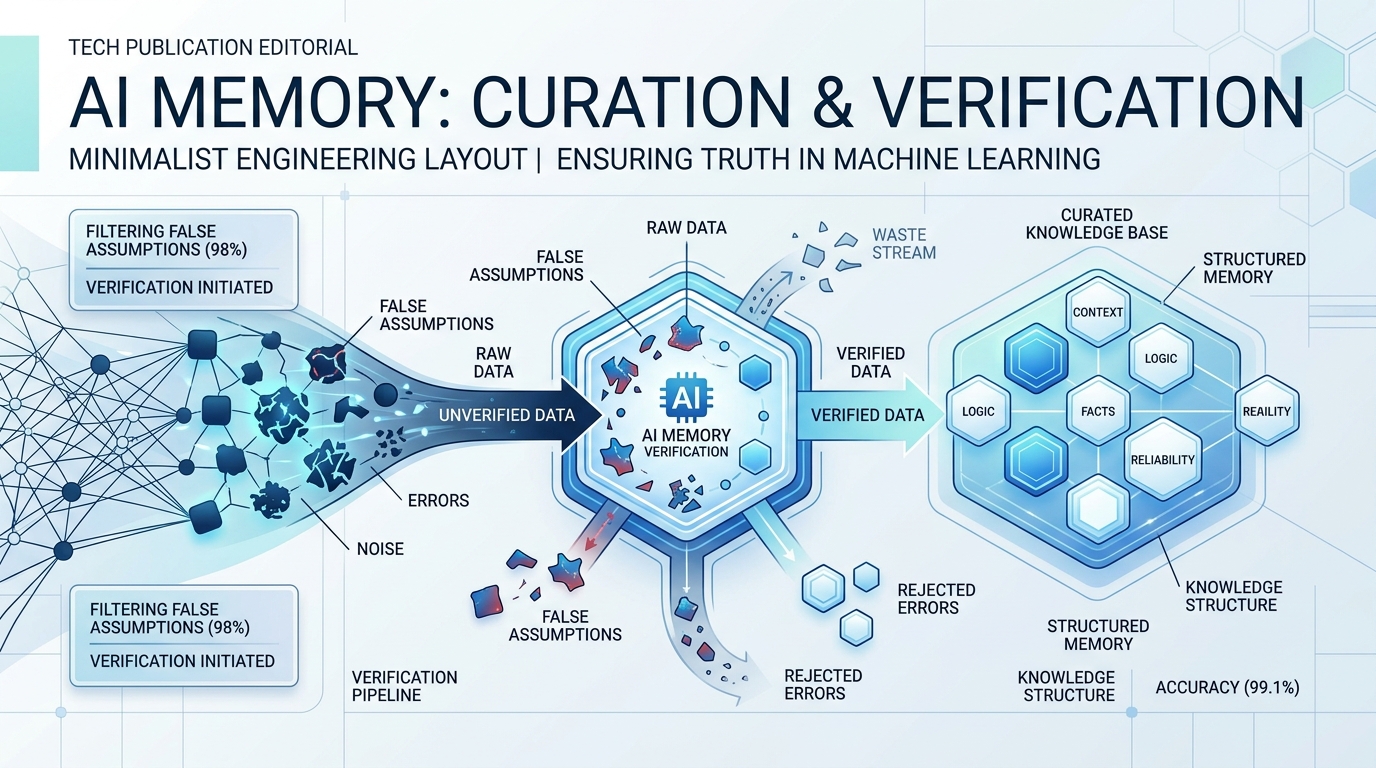
TL;DR
- Retrieval quality cannot repair a memory that was wrong when written.
- A useful observation in one context can easily become a misleading rule across tasks without environment grounding.
- Production agents need an admission layer to check claims before turning them into reusable advice.
- MemOS provides explicit lifecycle controls, source-linked metadata, and environment-probing curation.
Standfirst: Retrieval quality cannot repair a memory that was wrong when written. Production agents need an admission layer that distinguishes user statements, environment facts, model inferences, procedures, and high-impact state before any of them become durable memory. MemTensor’s MemOS provides an operating-layer architecture in which those lifecycle controls can be made explicit.
An agent may carry a mistaken assumption from one task into the next. Checking what it learns, keeping the source, and revisiting memories when conditions change can help prevent that mistake from spreading. MemOS gives developers tools to support this work, from processing new information to correcting existing memories.
When an agent gives a wrong answer, it is natural to inspect what it retrieved. The problem may have started earlier, with a memory built from an incomplete observation or a conclusion that was never checked.
In Grounding Agent Memory: Environment-Probing Curation for Enterprise Agents, Microsoft researchers gave a memory curator read-only access to the environment after a task ended. It could check uncertain claims and revise or skip records before later tasks used them.
In the paper’s 40-question CLBench experiment with schema changes, using GPT-5.4 in a GitHub Copilot SDK harness, the system with memory and environment probing reached a mean pass rate of 73%. The system with memory alone reached 70%, while the no-memory baseline reached 39%. Adding probing to the memory system also reduced average queries per question from 5.6 to 4.7 and task-agent cost from $1.99 to $1.68. These costs exclude the separate distillation and curation stages.
Those results describe the researchers’ setup. They raise a practical question for developers building with memory: what should an agent check before passing something it has learned to the next task?
A useful observation can become a misleading rule
Consider a database agent that finds the records it needs in a table called customers_current. It finishes the task and saves a note saying, “Use customers_current for active accounts.”
The query may have worked for one region or reporting period. The saved note leaves those conditions out, so another agent could apply it to a much broader question. Checking the table definition and the relevant business rules would help establish where the advice holds.
Even a carefully checked note can become outdated. A month later, the table might be replaced by a compatibility view that updates less frequently. Future agents need a way to recognize that change and update the memory.
Similar problems arise when an agent keeps recommending an API workaround after a fix, saves a temporary approval process as a permanent procedure, or records a failed command as a successful solution. A policy can lose its effective date during summarization. A rule for one customer can become advice for every customer.
In each case, the memory is missing something a future task needs: evidence, conditions, or an update. Retrieval can find the note, but the agent still needs enough information to judge whether it applies.
Check the claim before making it reusable
A memory workflow often starts with a conversation or task history, extracts useful information, and saves it for later retrieval. A verification step can check the extracted claims before they become reusable advice.
The original conversation and tool results can still be retained as evidence. The decision is which conclusions to make available to future tasks, and with what limits. Keeping that distinction also allows a team to inspect how a summary was produced if something goes wrong.
The check should match the information being saved.
| Information | What to check |
|---|---|
| A user statement or preference | Keep who said it, when, and the relevant context. “I prefer concise weekly summaries” can be recorded directly and changed when the user updates it. |
| A fact about the environment | Check the relevant system, such as a schema, repository, API specification, or policy document. Record the version or time observed. |
| An agent’s inference | Preserve the evidence and identify the conclusion as an inference. “This customer may be price-sensitive” should remain distinguishable from something the customer explicitly said. |
| A procedure or skill | Keep its prerequisites and the evidence that it worked. Use a test or acceptance condition appropriate to the procedure. |
Sensitivity and impact apply across these categories. A preference about report length needs less review than a remembered procedure that could change access permissions or authorize a payment.
Read-only checks are often enough to resolve uncertainty. A coding agent can inspect a symbol definition, and a database agent can examine a schema or query a limited sample. Procedures with side effects need a suitable test environment or other evidence of a successful result.
How MemOS supports the workflow
MemOS provides operations for adding, finding, correcting, and removing memories. Developers can use these operations alongside checks against their own business systems. The application chooses the authoritative source and implements the environment checks described above.
Keep the source with the memory
In the open-source service, MemReader processes conversations, documents, and images into memory items with source information. Developers can use the Add API’s info metadata to attach details such as the source location and application-supplied validation results.
For the database example, this could include the schema version, the time it was checked, and the business context in which the table should be used. If a later answer looks wrong, the team has a starting point for investigating it.
The verification step needs to cover the extracted claim. Checking an input document alone can miss an error introduced when the system turns that document into a shorter memory.
Conclusion
Agent reliability is not just a function of context length or retriever precision; it is defined by the integrity of the knowledge the agent commits to memory.
By combining environment-probing curation with structured admission controls and source attribution, teams can prevent transient noise and premature conclusions from crystallizing into permanent system bias. MemOS provides the foundational operating primitives to ensure that every durable memory remains verifiable, scoped, and safe to reuse.
Frequently Asked Questions
- Why can't retrieval quality fix bad agent memories?
- If a memory was derived from an incomplete observation or an unchecked inference, retrieving it accurately will simply propagate the error into future tasks.
- What is environment-probing curation?
- A pattern where a curator inspects the environment (schemas, code symbols, APIs) after a task ends to verify uncertain claims before committing them as durable memory.
- How does MemOS support source tracking in memory?
- MemOS processes conversations and documents with source information, allowing developers to attach metadata such as schema versions, timestamps, and validation results.
- How should an agent categorize information before saving?
- It should distinguish user preferences, environment facts, model inferences, and executable procedures, applying appropriate verification to each.