
TL;DR
- A useful knowledge base starts with the decision a reader must make, not with keyword volume or page count.
- Every changing claim needs a source, verification date, applicable build, confidence level and current status; when evidence is missing, say unknown.
- Localization, static HTML, interactive state and release notifications must preserve the same evidence boundary and pass separate production checks.
This article is for people responsible for technical documentation, product help centers, industry databases, game wikis or multilingual content sites. By the end, you should be able to write a minimum trustworthy-content contract for your own project and decide what belongs in editorial review, build automation and production verification.
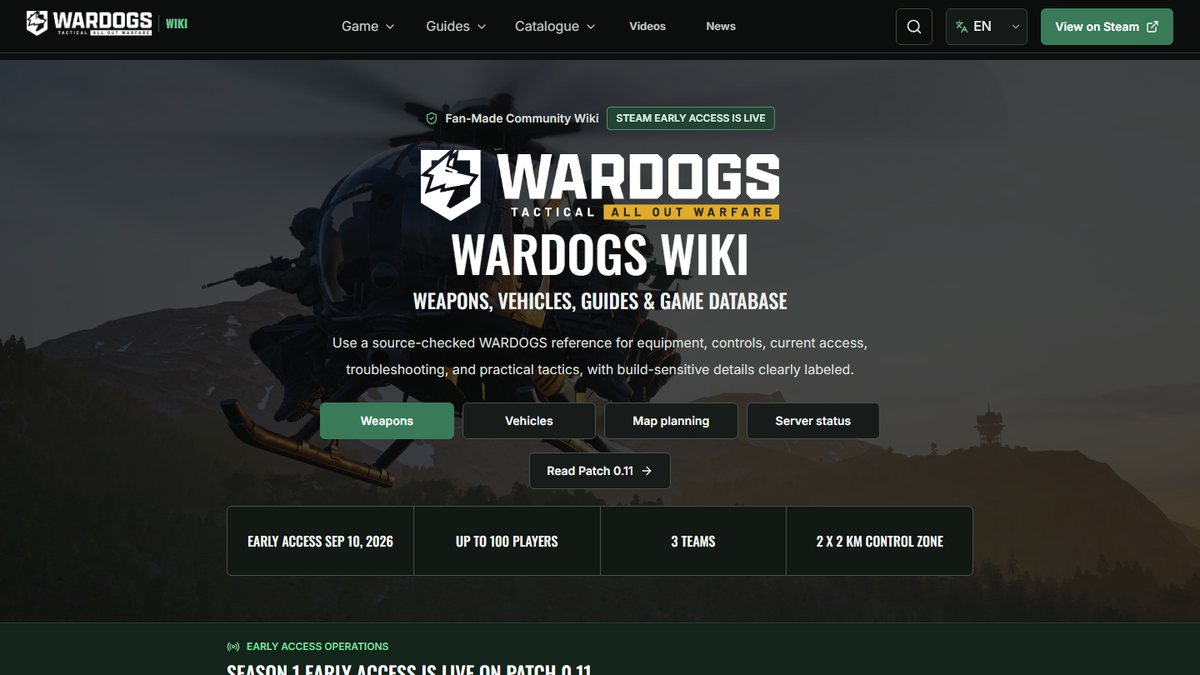
WARDOGS Wiki is an independently operated, unofficial player reference. It is neither the game’s official site nor a T Salon community product. It makes a useful case study because several problems that content teams usually handle separately occur in one system: facts change between game builds, evidence arrives through sources of unequal strength, 54 topics must stay aligned across six languages, and pages must work for search engines, AI retrieval and interactive tools.
A conventional project retrospective begins with what the team built. That usually becomes a feature inventory. Borrowing Amazon’s Working Backwards discipline, we begin with the customer problem, the intended experience and the questions that must be answered before choosing pages or features. This article does not copy the PR/FAQ format, but it keeps the same constraint: every investment must explain which reader decision it improves. Why did somebody open the page? What decision are they about to make? What happens if the answer is stale, overconfident or missing its scope?
That change in starting point produces a different content system.
Define what the reader should leave with
Someone searching for a weapon, a test window or a technical problem is rarely asking for an article. They are preparing to act: spend in-game currency, update the client, change a route, or continue troubleshooting a machine.
The product of a knowledge base is therefore not prose. It is an answer strong enough to support the next decision. For WARDOGS Wiki, a useful answer must resolve five questions:
- What can be confirmed now?
- What evidence supports it?
- Which date and game build does it describe?
- What remains unknown, disputed or incomplete?
- What can the reader do next?
The same questions apply to API documentation, model pricing, cloud limits, browser compatibility and policy trackers.
| Reader question | Complete-looking but weak answer | Decision-ready answer |
|---|---|---|
| Can I use this feature? | Repeats product claims | States current status, applicable build, limitations and verification date |
| Is this number accurate? | Publishes an unsourced value | Names the source, observation context and confidence; marks it unknown when evidence is insufficient |
| Why does another page disagree? | Silently overwrites the old page | Separates the current conclusion from historical evidence and records why it changed |
| Can I share this result? | Confirms only that the route opens | Restores the same interactive state from the URL and exposes the core answer in indexable HTML |
If a page cannot do this, more FAQs, schema markup and keyword coverage do not create usefulness. Those techniques can amplify the content that exists. They cannot supply a missing fact or a missing boundary.
Turn “trustworthy” into a promise the team can test
“Keep the content accurate” is an aspiration, not an acceptance criterion. Working backward requires a promise that a reader can experience and a team can verify.
A practical promise for a fast-changing knowledge base is:
Within 30 seconds, a reader can find the current answer, its source, its time scope and its uncertainty. When the answer changes, the team can identify every affected locale and page, then prove that production serves the new version.
That sentence has architectural consequences:
- critical answers cannot exist only in screenshots, videos or client-side widgets;
- “last updated” is insufficient unless the page says which claim was verified and when;
- a translator cannot turn “observed” into “confirmed”;
- historical evidence may remain available but cannot masquerade as the current answer;
- a passing build, a deployment, a readable production page and an indexed URL must remain separate statuses.
In a build produced on September 29, 2026, 54 WARDOGS Wiki subjects generated 324 localized guides across English, Russian, German, Brazilian Portuguese, Japanese and Simplified Chinese. The same site also generated catalogue records, video pages, news, maps and planning tools. The scale is not the achievement. It shows why memory and manual reminders stop working.
The minimum trustworthy-content contract
Many sites put sources at the bottom of an article and an update date at the top. Neither is bound to an individual claim, so a reader still cannot tell which observation supports a specific number.
A more reliable model treats every changing fact as a bounded record. A minimum contract might look like this:
claim: the conclusion presented to the reader
sourceClass: official | observed | creator | community
sourceUrl: the original evidence
verifiedAt: the last verification date
validFor: applicable build, region or device scope
confidence: confirmed | observed | corroborated | unverified
status: current | historical | disputed | unknown
locales: translations carrying the same evidence boundary
This structure is not paperwork for its own sake. It gives the system enough information to reject incomplete records.
| Source class | What it can support | Boundary it cannot cross |
|---|---|---|
| Official pages and announcements | Release dates, platforms, builds and explicitly published features | Does not automatically prove behavior in the live client |
| Current game client | Repeatable interfaces, items and interactions | Must name the observed build and cannot predict a future update |
| Creator gameplay footage | A workflow or behavior visible in a named build | Old footage cannot be presented as current state |
| Community reports | Troubleshooting leads and patterns that need reproduction | Cannot establish global status or an official conclusion |
The most valuable property of this model is that it permits an honest “unknown.” If a price appears only in footage from an older test, the correct state may be historical or unknown. Publishing a precise-looking number to fill a field creates false confidence.
The public WARDOGS Wiki editorial policy distinguishes official facts, observed behavior, community evidence and unresolved information. That helps a reader more than a generic disclaimer because it says which part of an answer can be trusted, to what degree and for which build.
Localize the evidence boundary, not just the sentence
The highest-risk localization failure is not an untranslated paragraph. It is a change in certainty. One locale says “observed”; another says “confirmed.” English receives the current date while another page preserves an obsolete value. Those differences change decisions.
WARDOGS Wiki uses a shared topic manifest to control slugs, categories and coverage. All six locale directories must contain the same subjects. Titles, descriptions, update dates, FAQs and source fields pass schema validation. The build can catch:
- a missing topic in one locale;
- a slug that diverges from the manifest;
- a source without a verification date or from a disallowed host;
- required metadata that breaks the content contract;
- an MDX component that the renderer does not permit.
Automation still cannot decide whether a translation overstates the evidence. The useful division of work looks like this:
| Question | Automate | Keep editorial judgment |
|---|---|---|
| Does every locale have the topic? | Yes | No |
| Do routes, fields and source formats match? | Yes | No |
| Did “observed” become “proven”? | Flag likely cases | Yes |
| Does an old conclusion still belong on the current page? | Expose dates and diffs | Yes |
| Which source wins when two credible sources conflict? | Preserve the conflict | Yes |
Localization parity should mean that every language preserves the same scope of evidence. Similar word counts are not a quality standard.
Keep the current answer and the historical record, but give them different jobs
Fast-moving products create an apparent dilemma. Delete old content and the change history disappears; keep it and a new reader may follow obsolete instructions.
The answer is to make “current” and “historical” explicit states. The current page serves today’s decision. Historical records explain why the conclusion changed. Every record retains its verification date, applicable build and reason for replacement.
A simple placement rule is enough to begin:
- information that changes today’s action belongs in the current answer;
- evidence that explains only an older build belongs in a historical snapshot;
- conflicting evidence remains disputed and displays the conflict;
- claims without sufficient evidence remain unknown.
This model extends beyond games. Model prices, cloud quotas, browser support and regulations all need time boundaries. A system that stores only the latest value cannot explain a change. A page that mixes every era into one narrative cannot guide a current decision.
Indexability and interactivity are different acceptance problems
WARDOGS Wiki includes weapon comparison, ammunition matching, loadout budgeting, progression routing, system checking and logistics planning. A user should be able to copy a URL and let another person open the same comparison or route.
During one static-export cycle, tool pages read server-side searchParams, preventing Next.js App Router from generating static output. The quickest way to turn the build green was to remove shared query state. That would have fixed the metric while breaking the user’s job.
The final design worked backward from two consumers:
- crawlers and AI systems need stable, meaningful server-rendered HTML;
- people opening a shared URL need the browser to restore the encoded interactive state.
The server therefore renders a deterministic default, and the client restores query state after loading. Acceptance is split too: inspect the exported HTML for the core answer, then open the shared URL in a browser and verify state restoration and same-origin assets.
The reusable lesson is larger than a Next.js technique: do not substitute “the build passes” for “the user completes the task.”
When a page looks broken, identify the failing layer first
The interactive map once appeared empty long enough to look broken. Rewriting map logic would have been a plausible first response. Browser checks instead showed that all three basemap requests started, their image hashes differed, and switching maps reset position and zoom correctly. The actual issue was delivery: each basemap was roughly 1.9–2.1 MB, so a slow first request looked like a dead interface.
The diagnostic order works for maps, screenshots, video and large data files:
- Did the request start?
- What status, content type and transfer size came back?
- Do different selections resolve to different assets?
- Does switching reset the required interaction state?
- Should the remedy be compression, caching, preloading or clearer loading feedback?
“The code never ran,” “the request failed” and “the asset arrived slowly” can look identical to a reader. They require different fixes. Locating the failure layer prevents a delivery problem from turning into an unnecessary rewrite.
Definition of done must reach production
Content teams often collapse several states into “done.” A useful release model keeps at least five states separate:
| State | What it proves | What it does not prove |
|---|---|---|
| File complete | Editorial work exists | The build can consume it |
| Build passed | Schema, routes and assets satisfy build rules | The production domain changed |
| Deployment completed | The platform produced a deployment | The domain points to it and critical pages work |
| Production verified | A user can retrieve the intended content | A search engine discovered or indexed it |
| Webmaster data refreshed | A search platform reprocessed the page | The page will receive impressions, citations or rankings |
The WARDOGS Wiki release path snapshots the live sitemap, deploys, verifies the production revision, critical pages, canonical URLs, redirects and clean 404 behavior, then compares old and new sitemaps before notifying IndexNow about changed URLs.
An accepted IndexNow response proves that the notification was received. It does not prove crawling, indexing or ranking. Keeping these states distinct makes reporting honest and tells the team exactly what to inspect next.
A checklist you can apply to your own knowledge base
You do not need to rebuild an entire site first. Begin with the 20 pages that receive the most traffic, change most often or carry the highest cost when wrong.
Content
- Every core claim names a source class and original source.
- Changing facts include a verification date and applicable version.
- Current, historical, disputed and unknown are visible states.
- The first screen answers the question before adding background.
- Critical claims shown in images or video also exist as readable text.
Localization
- A shared manifest controls subjects, slugs and required fields.
- Every locale carries the same factual status and version scope.
- Automation checks missing pages, broken links, dates and fields.
- Editors review negation, confidence words and tense so certainty does not increase in translation.
Engineering
- Server-rendered HTML contains the core answer.
- Interactive state can be restored from a URL.
- Build tests exercise real indexable routes and same-origin assets.
- Large resources expose size, loading state and failure feedback.
- A 404 does not publish an indexable canonical or misleading structured data.
Release
- The previous and current production revisions are identifiable.
- The live domain, canonical URL, redirects and sitemap are fetched after deployment.
- Only URLs that were added, changed or removed are submitted.
- Notification accepted, crawled and indexed are recorded separately.
When these constraints are not worth the cost
A small brochure site with a few stable pages, one language and no interactive state may not benefit from a content contract this detailed. Working backward also means refusing engineering that produces no user value.
Three signals justify the investment:
- A wrong answer can cause a wrong decision.
- The same fact appears across multiple pages, languages or product surfaces.
- Facts change faster than editors can synchronize them reliably from memory.
If two of the three are true, establish a minimum trustworthy-content contract before adding more pages.
WARDOGS Wiki’s useful output is not simply 324 localized guides. It is a set of enforceable rules for what can be claimed, where the claim applies and how the team proves that readers received the new version. All of that engineering serves one reader outcome: after opening a page, a person knows what they can safely do next.
Explore the live WARDOGS Wiki and use its public editorial policy to assess how the site presents sources, freshness and uncertainty.